
AB-900A Biconical Antenna
AB-900A with collapsible elements: Broadband operating range covering 25 MHz to 300 MHz for EMC emissions and immunity work
• Linearly polarized biconical design with flexible elements; one available option includes collapsible elements for compact storage and transport
• 50 Ω impedance with N-type (female) RF connector
• Suitable for both transmit (up to 50 W) and receive applications across the full band
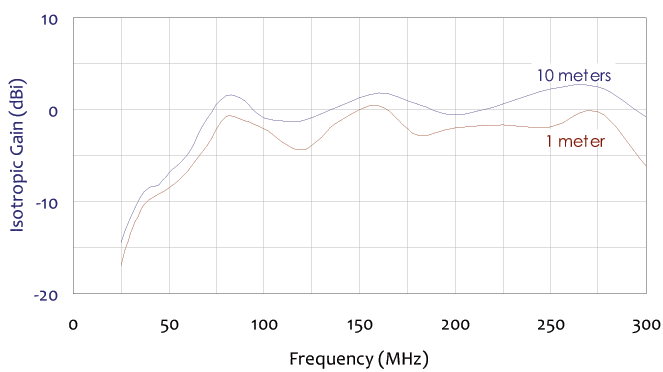
• Stable antenna factor and gain characteristics for repeatable, traceable EMC measurements
• Lightweight construction for easy mounting on standard EMC tripods and antenna masts
• Commonly used for radiated emissions measurements in accordance with CISPR and ANSI C63 standards
• Suitable as a transmitting antenna for radiated immunity setups per IEC 61000-4-3 and related automotive/military test methods
- Frequency Range: 25 MHz to 300 MHz
- Transmit & Receive Capabilities emissions/immunity applications
- Individual Calibration Included per ANSI C63.5 with NIST traceability
- Three-year Standard Wararanty
- Frequency Range: 25 MHz to 300 MHz
- Polarization: Linear
- Nominal Impedance: 50 Ohm
- Power Handling: 50 Watts Continuos
- Connector: N-type(female)
- Test Specifications: FCC, CISPR, EN, ETSI, FAA, MIL-STD 461, Automotive, etc
- Width: 52.75 in / 134 cm
- Dimensions (L x W x D): 51.5” x 20.2” x 27.2” [130.8 x 51.3 x 69.1 cm]
🔍 Not Sure Which Antenna You Need?
Compare all Com-Power antenna models side-by-side with our interactive selection tool. Filter by frequency range, antenna category, application, polarization, and power handling to find your perfect match.
Compare All Antenna Models →AB-900A Biconical Antenna – Technical FAQs
1. What is the AB-900A biconical antenna and where is it used in EMC testing?
The AB-900A is a broadband biconical antenna covering 25 MHz to 300 MHz, used for radiated emissions and immunity testing. In real EMC labs, it is commonly used to test automotive electronics, industrial controllers, cable harnesses, and communication systems where emissions in the VHF band are critical.
2. What is the difference between AB-900A and AB-300M?
Both operate in the same frequency range, but the AB-900A emphasizes collapsible element design for portability and ease of transport, while AB-300M offers more configuration flexibility. Functionally, both serve similar roles in emissions and immunity testing.
3. When should you use a biconical antenna instead of a log periodic antenna?
Use a biconical antenna below ~300 MHz where broadband low-frequency coverage is required. Log periodic antennas are preferred above this range due to higher gain and smaller size.
4. What real-world problems can this antenna help identify?
It helps detect emissions from: - Long cable radiation - Switching power supplies - Ground loops - PCB layout issues These are common failure points in EMC compliance.
5. What standards require this type of antenna?
The AB-900A is used in FCC, CISPR, EN, MIL-STD-461, and DO-160 testing. It is also used in chamber validation and NSA testing.
6. Can the AB-900A be used for immunity testing?
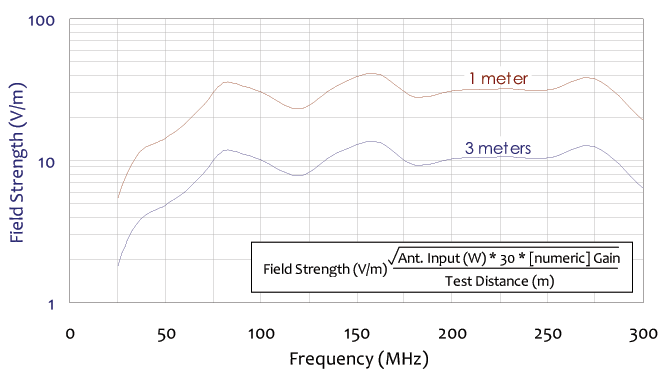
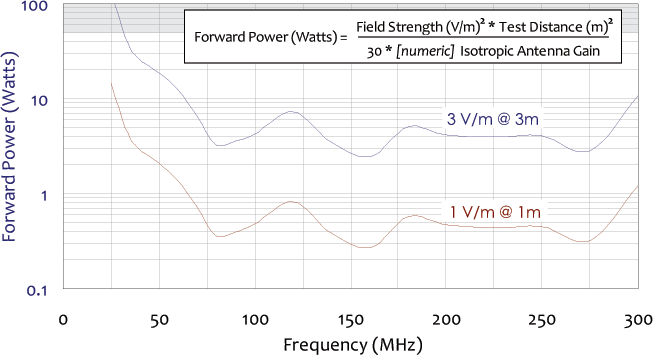
Yes, it supports transmit mode up to 50W and is used with amplifiers to generate RF fields for immunity testing.
7. What industries use this antenna?
Automotive, aerospace, defense, industrial electronics, and consumer electronics manufacturers commonly use this antenna.
8. What are real-world immunity use cases?
Used to test ECUs, avionics systems, and industrial equipment to ensure they operate correctly under RF exposure.
9. How does it compare to a horn antenna?
Horn antennas operate at higher frequencies (above ~700 MHz), while biconical antennas are ideal for lower frequencies.
10. Why is linear polarization important?
It allows controlled measurement of emissions in specific orientations, which is required by EMC standards.
11. What is the benefit of collapsible elements?
They make the antenna portable and easy to store, which is useful for field testing and mobile labs.
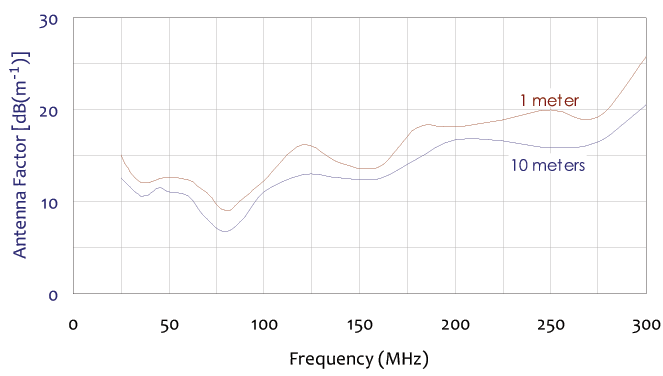
12. What is antenna factor and why does it matter?
Antenna factor converts measured voltage into field strength. Accurate calibration ensures compliance measurements are valid.
13. Can this antenna be used for pre-compliance testing?
Yes, engineers use it early in development to identify EMI issues before certification testing.
14. What test setups commonly use this antenna?
Used in: - Semi-anechoic chambers - Open area test sites - EMC pre-compliance labs
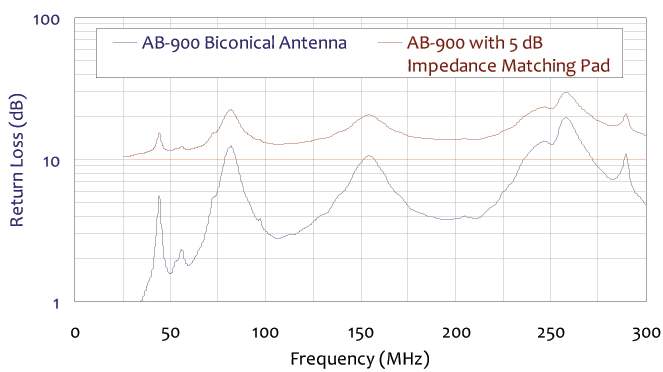
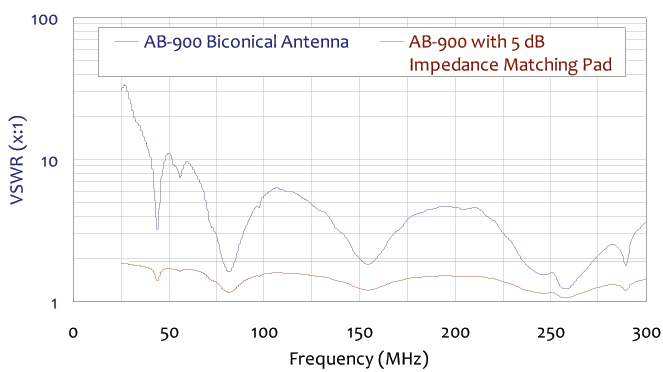
15. How does impedance matching affect results?
Proper matching reduces reflections and improves measurement accuracy.
16. How does this compare to monopole antennas?
Monopoles are used below 30 MHz for E-field, while biconical antennas are used above that range.
17. Why choose AB-900A?
It provides broadband coverage, compliance with major standards, portability, and reliable measurement performance.
Application Notes (PDF)
- AN-107 — What is Antenna Factor?
- AN-106 — Use of Antenna Factor for EMC Measurements
- Selecting the Right EMI Antenna
- Considerations when Selecting an Antenna for RF Immunity Testing
- EMC Antenna Calibration Requirements, Methodologies, and Best Practices
- NIST Antenna Calibration Services — Com-Power Capabilities and Traceability
- Com-Power EMC Antenna Product Line — Complete Specifications
- Accounting for Ambient Noise
Interactive Tools
- Antenna Finder Wizard
- Com-Power Antenna & Field Strength Calculator
- Com-Power EMC Compliance Limits Calculator
- Com-Power Cable Loss & Attenuation Calculator
- Com-Power VSWR / Return Loss / Mismatch Loss Calculator
- Com-Power Free Space Path Loss & Link Budget Calculator
Industry Applications
- EMC Considerations for IoT and Smart Home Devices
- Automotive EMC Testing — ISO 11452 / CISPR 25
- 5G Equipment EMC Testing — New Challenges in EMC Compliance
- Medical Device EMC Compliance — IEC 60601-1-2 Essentials
- EV Charging Systems — EMC Requirements and Compliance
Blog Articles


Quote Request
Other EMC Test Equipment
- Absorbing Clamps
- Antenna Kits
- Antenna Masts - Automated and Manual
- Antennas
- Bulk Current Injection probes
- CDNs - Coupling Decoupling Network
- Comb Generators
- Conducted Immunity Test Systems
- Current Monitor Probes
- Current Probe Calibration Fixtures
- EM Clamps
- Feed Through Capacitor
- ISNs - Impedance Stabilization Network
- LISNs - Single Phase
- LISNs - TEMPEST
- LISNs - Three Phase
- Magnetic Field Generator
- Near Field Probes
- Power Amplifiers
- Pre-compliance Emissions Test Systems
- Preamplifiers
- Spectrum Analyzers
- Surge Generators
- System Controllers
- Transient Limiters
- Tripods For EMC
- Turntables