
AC-220 Hybrid Combilog Antenna
AC-220 CombiLog Antenna:
-
Frequency Range: 20 MHz–2 GHz (emissions), 80 MHz–2 GHz (immunity)
-
Hybrid Design: Combines log periodic and biconical (bow-tie) elements
-
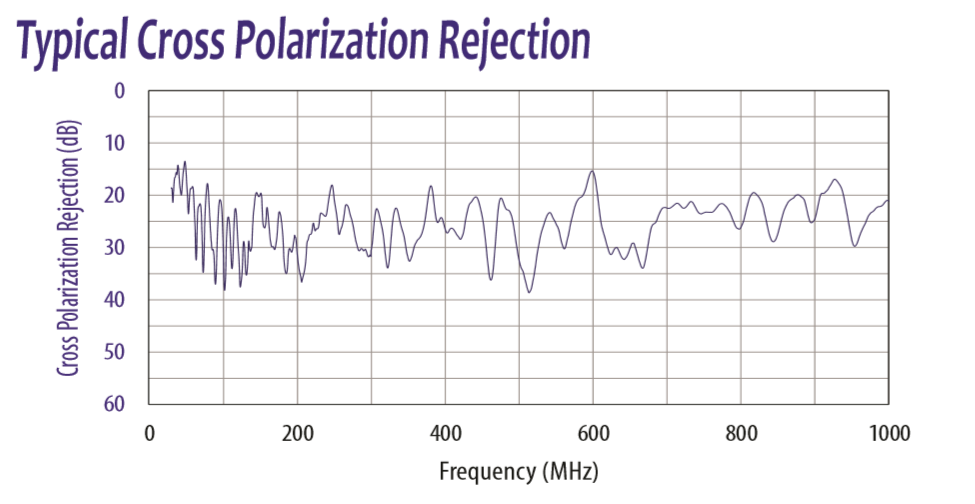
Polarization: Linearly polarized with good cross-polarization performance
-
Calibration: Individually calibrated to ANSI C63.5 with NIST traceability
-
Power Handling: Up to 500 Watts for immunity testing
-
Applications: EMI testing, immunity tests, shielding tests, site surveys
-
Compliance: Meets ANSI C63.5 and CISPR 16-1-4 balance/symmetry specs
-
Mounting: 1/4” x 20 thread; compatible with AT-812 Tripod, AM-400 Mast
-
Warranty: Standard 3-year warranty
-
Advantage: Replaces up to 4 separate antennas with a single hybrid unit
- Wide Frequency Range : 20 MHz to 2 GHz (emissions) 80 MHz to 2 GHz (immunity)
- Complies with ±1 dB Antenna Symmetry/Balance Requirements of ANSI C63.5 and CISPR 16-1-4
- Good Cross-Polarization Performance
- Transmit & Receive Capabilities
- Individual Calibration Included
- Three-year Standard Warranty
- Product Name: CombiLog Antenna
- Frequency Range: 20 MHz to 2 GHz (as receive antenna - emissions) / 80 MHz to 2 GHz (as transmit antenna - immunity)
- Polarization: Linear
- Nominal Impedance: 50 Ω
- Power Handling: (CW) 500 Watts (continuous)
- Connector: N-type (female)
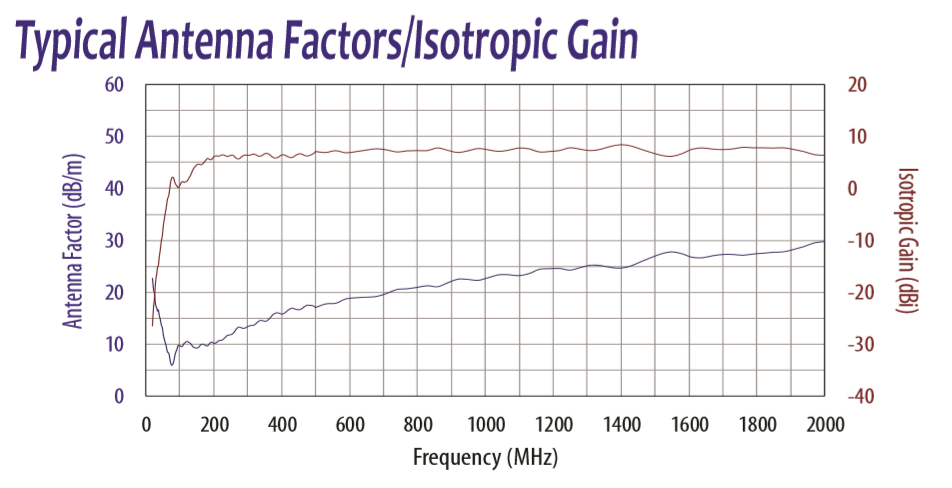
- Antenna Factor: 6.2 to 27.7 (average: 16.9) [dB(m-1)]
- Isotropic Gain: -18.5 to 9.2 (average: 3.0) dBi
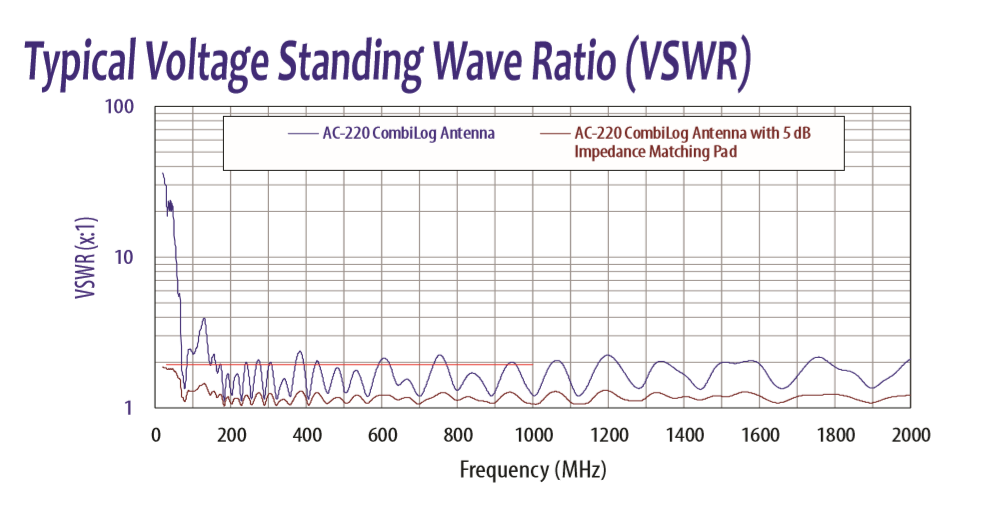
- VSWR: 1.06 to 3.93 (average: 1.78) :1
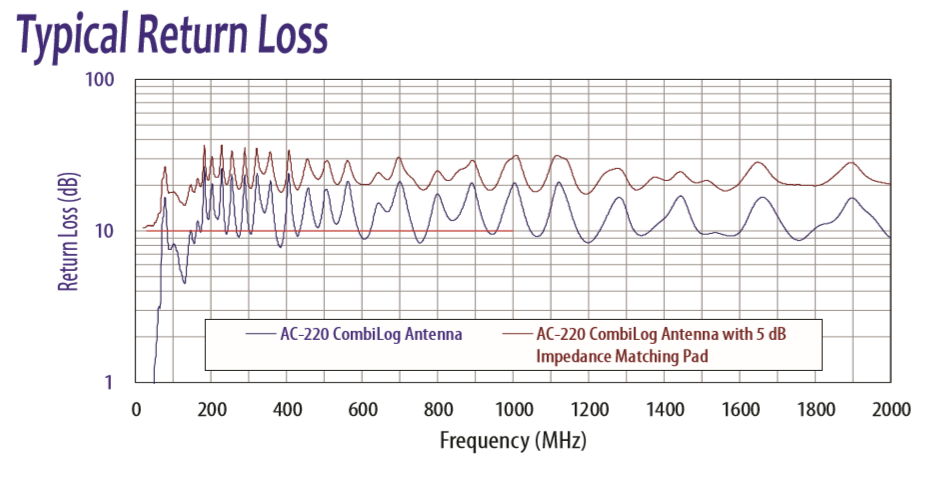
- Return Loss: 4.5 to 29.8 (average: 12.5) dB
- Specifications: FCC, CISPR, EN, ETSI, etc.
- Dimensions: (H x W x D) 50
🔍 Not Sure Which Antenna You Need?
Compare all Com-Power antenna models side-by-side with our interactive selection tool. Filter by frequency range, antenna category, application, polarization, and power handling to find your perfect match.
Compare All Antenna Models →AC-220 CombiLog Hybrid Antenna – Frequently Asked Questions
1. What is the AC-220 CombiLog hybrid antenna and what is it designed to do?
The AC-220 CombiLog hybrid antenna is a broadband EMC hybrid antenna that combines biconical and log periodic elements into one structure. It is designed to cover 20 MHz to 2 GHz for radiated emissions measurements and 80 MHz to 2 GHz for radiated immunity testing. In practical EMC work, this means one antenna can replace multiple separate antennas that would normally be required to cover low-band and high-band measurements. For compliance laboratories, pre-compliance labs, and engineering teams, that makes the AC-220 a strong choice when the goal is to simplify test setups, reduce antenna changes, and maintain consistent wideband measurement coverage. It is also described as a BiconiLog or hybrid biconical log periodic antenna, which reflects its combined operating principle.
2. How does a CombiLog antenna differ from a standard biconical antenna?
A standard biconical antenna is usually optimized for lower radiated EMC bands, especially where broad low-frequency coverage is needed. A CombiLog antenna such as the AC-220 extends the useful range much higher by integrating log periodic elements into the same antenna body. The result is a single antenna emissions and immunity solution that spans a much wider range than a traditional biconical antenna alone. In real test environments, this is valuable because engineers can run broader sweeps without stopping to swap antennas, reconnect cables, adjust mast positioning, or repeat setup checks. That improves efficiency and also reduces the chance of introducing measurement variation from one antenna change to the next.
3. How does the AC-220 compare with a log periodic antenna?
A log periodic antenna generally performs well over higher frequency ranges and often provides useful directivity and gain in those bands. However, a log periodic antenna by itself does not usually provide the same low-frequency coverage as a hybrid antenna that includes biconical or bow-tie style elements. The AC-220 is designed to bridge that gap. Compared with a standalone log periodic antenna, the AC-220 provides broader practical coverage for broadband EMI antenna use, especially when a lab needs to cover both lower and higher test bands with fewer hardware changes. This is particularly useful in commercial EMC testing, product development, chamber sweeps, and multi-standard qualification programs.
4. What are the main advantages of the AC-220 in real EMC lab workflows?
One of the main advantages of the AC-220 is that it can replace up to four antennas, which directly reduces test complexity. In a busy EMC lab, antenna changes take time and can create delays in chamber scheduling, cable routing, amplifier switching, and recalibration checks. By using one wideband EMC antenna across a large portion of the radiated test spectrum, labs can reduce testing time, improve repeatability, and simplify operator workflow. This can be especially useful during full-band troubleshooting, product comparisons, chamber investigations, and certification preparation, where speed and consistency matter. The page also highlights that the AC-220 can reduce test time by up to 30%, which is a meaningful benefit for throughput-driven labs. :contentReference[oaicite:2]{index=2}
5. What frequency ranges does the AC-220 cover for emissions and immunity testing?
The AC-220 is specified for 20 MHz to 2 GHz as a receiving antenna for radiated emissions and 80 MHz to 2 GHz as a transmitting antenna for immunity testing. That split is important because receiving and transmitting applications do not always start and stop at the same frequency boundaries in practical EMC systems. For emissions measurements, the antenna supports broadband receiving coverage beginning at 20 MHz. For immunity work, the antenna supports transmit-mode operation from 80 MHz upward, which aligns well with common radiated immunity practices such as IEC 61000-4-3 style testing and related RF susceptibility evaluations. :contentReference[oaicite:3]{index=3}
6. Can the AC-220 be used for both radiated emissions and radiated immunity testing?
Yes. The AC-220 is specifically designed for both radiated emissions antenna use and immunity testing antenna use. In receive mode, it is used to measure unwanted electromagnetic emissions from equipment under test. In transmit mode, it can be driven by a power amplifier to generate RF fields for immunity or susceptibility testing. This dual-use capability is one of the strongest reasons to choose a hybrid CombiLog antenna. In real-world EMC programs, the ability to use one antenna for both measurement and field generation helps standardize the setup, reduce equipment changes, and make workflows more efficient across product qualification cycles.
7. Why is 500 watt continuous power handling important on the AC-220?
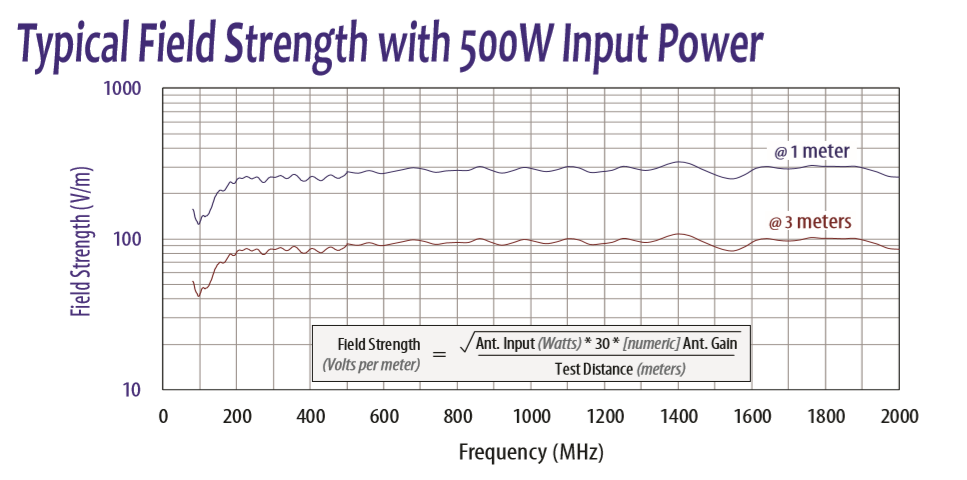
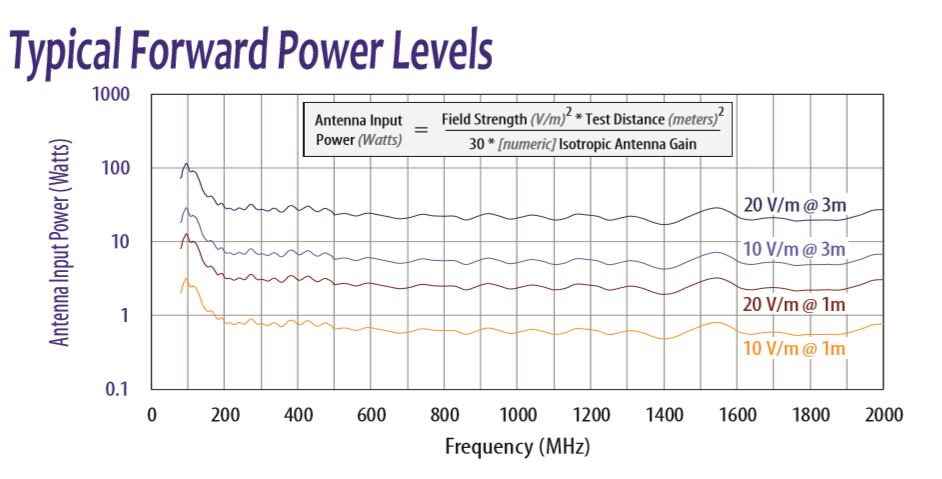
The AC-220 is rated for 500 watts continuous power handling, which is significant for radiated immunity testing because the antenna must safely accept amplifier power across a broad frequency range. High power handling allows the antenna to support stronger electric field generation, compensate for chamber losses, and meet tougher test levels without operating near the antenna’s limit. In real applications, this matters when testing automotive electronics, industrial equipment, medical systems, or commercial products that must demonstrate immunity under demanding RF exposure conditions. A high power EMC antenna like the AC-220 provides more flexibility in immunity setups than a lower-power broadband antenna. :contentReference[oaicite:4]{index=4}
8. What EMC standards and test programs is the AC-220 intended for?
The product information shows that the AC-220 is suitable for FCC, CISPR, EN, and ETSI requirements, and it is individually calibrated to ANSI C63.5 with NIST traceability. It also meets ±1 dB antenna symmetry/balance requirements consistent with ANSI C63.5 and CISPR 16-1-4. In practical terms, this means the antenna is aligned with widely used commercial EMC frameworks and can support both product compliance work and broader measurement tasks such as site survey work, shielding evaluations, and general chamber investigations. :contentReference[oaicite:5]{index=5}
9. Why is antenna symmetry and balance important for EMC measurements?
Antenna symmetry and balance are important because they affect how consistently the antenna responds across orientations and frequencies. If a broadband antenna is poorly balanced, measurement results can vary more than expected and may increase uncertainty. The AC-220 is described as meeting ±1 dB symmetry/balance requirements, which is a strong indicator that it is built for compliance-grade work rather than casual RF observation. In EMC testing, this matters because labs need antennas that provide repeatable, traceable, and defensible results, especially when comparing data across different chambers, setups, operators, or time periods. :contentReference[oaicite:6]{index=6}
10. What does linear polarization mean for the AC-220, and why does it matter?
The AC-220 is a linearly polarized antenna, meaning it transmits or receives one linear field orientation at a time. In EMC testing, polarization is important because the emissions or susceptibility of an equipment under test can change depending on the field orientation relative to the product, cable routing, enclosure geometry, or PCB layout. A linearly polarized hybrid antenna allows controlled test setups and helps labs perform the orientation changes required in standard radiated measurement procedures. This is one of the reasons linear polarization remains standard in many compliance-oriented antenna designs.
11. What real-world product types are commonly tested with the AC-220?
The AC-220 is suitable for many product categories that require wideband radiated EMC coverage. These include consumer electronics, industrial electronics, automotive systems, IT equipment, and many commercial electronic assemblies that must meet radiated emissions or immunity requirements. It is useful wherever products contain switching electronics, digital clocks, cable interfaces, control boards, displays, embedded radios, or power conversion hardware that can create emissions across a wide band. It is also useful in engineering labs that need one EMI testing antenna to support multiple programs without maintaining several separate lower-band and upper-band antennas. :contentReference[oaicite:7]{index=7}
12. Can the AC-220 be used for shielding effectiveness measurements and site surveys?
Yes. The AC-220 is described as suitable for shielding effectiveness measurements and site surveys. These are important secondary applications because EMC labs often need more than product compliance testing alone. For example, engineers may want to evaluate enclosure leakage, compare chamber behavior, inspect measurement areas for unexpected RF conditions, or investigate whether a site is suitable for particular test tasks. A single antenna emissions immunity platform that also supports surveys and shielding work can reduce the number of specialized antennas a lab needs to keep ready.
13. How does the AC-220 compare with the ACL-6000 CombiLog antenna?
The biggest difference is frequency coverage. The AC-220 covers up to 2 GHz, while the ACL-6000 extends the concept much higher, up to 6 GHz. That means the AC-220 is a strong fit for many traditional EMC programs, especially where coverage through 2 GHz is sufficient, while the ACL-6000 is better suited for applications that must address higher-frequency electronics, newer wireless products, and broader radiated scans. In other words, the AC-220 is an excellent time saving EMC antenna for a large share of standard compliance work, while the ACL-6000 is the broader-band option when more modern high-frequency coverage is required.
14. How does NIST-traceable calibration help with compliance and lab confidence?
The AC-220 is individually calibrated to ANSI C63.5 with NIST traceability. This matters because raw antenna hardware alone is not enough for compliance-quality measurements. Engineers need known calibration data so that the measured voltage at the receiver can be converted into meaningful field strength values with confidence. NIST traceability provides a recognized measurement chain back to national standards, helping support internal quality procedures, customer confidence, and formal compliance documentation. In many accredited or customer-facing environments, this level of calibration is a basic requirement rather than an optional extra. :contentReference[oaicite:9]{index=9}
15. What mounting and lab integration details are important for the AC-220?
The AC-220 uses a 1/4 inch x 20 mounting thread and is compatible with the AT-812 tripod and AM-400 antenna mast. These details matter because mechanical stability and repeatable positioning are fundamental in radiated EMC testing. An antenna that is easy to mount correctly saves time, improves repeatability, and reduces alignment mistakes. In real chamber use, mounting convenience directly affects throughput and test quality, especially when engineers must repeat the same setups across many products or test sessions. :contentReference[oaicite:10]{index=10}
16. Why would an EMC lab choose the AC-220 over several separate antennas?
An EMC lab may choose the AC-220 because it provides a rare combination of wide coverage, dual transmit/receive use, high power handling, standards-oriented symmetry performance, and time-saving workflow benefits. Instead of managing multiple antennas, multiple mounting changes, and more frequent reconfiguration, the lab can rely on one CombiLog antenna for a broad range of tasks. For labs focused on productivity, repeatability, and lower setup complexity, the AC-220 can be a very practical upgrade over traditional multi-antenna radiated test setups.
Application Notes (PDF)
- AN-107 — What is Antenna Factor?
- AN-106 — Use of Antenna Factor for EMC Measurements
- Selecting the Right EMI Antenna
- Considerations when Selecting an Antenna for RF Immunity Testing
- EMC Antenna Calibration Requirements, Methodologies, and Best Practices
- NIST Antenna Calibration Services — Com-Power Capabilities and Traceability
- Com-Power EMC Antenna Product Line — Complete Specifications
- Accounting for Ambient Noise
Interactive Tools
- Antenna Finder Wizard
- Com-Power Antenna & Field Strength Calculator
- Com-Power EMC Compliance Limits Calculator
- Com-Power Cable Loss & Attenuation Calculator
- Com-Power VSWR / Return Loss / Mismatch Loss Calculator
- Com-Power Free Space Path Loss & Link Budget Calculator
Industry Applications
- EMC Considerations for IoT and Smart Home Devices
- Automotive EMC Testing — ISO 11452 / CISPR 25
- 5G Equipment EMC Testing — New Challenges in EMC Compliance
- Medical Device EMC Compliance — IEC 60601-1-2 Essentials
- EV Charging Systems — EMC Requirements and Compliance
Blog Articles


Quote Request
Other EMC Test Equipment
- Absorbing Clamps
- Antenna Kits
- Antenna Masts - Automated and Manual
- Antennas
- Bulk Current Injection probes
- CDNs - Coupling Decoupling Network
- Comb Generators
- Conducted Immunity Test Systems
- Current Monitor Probes
- Current Probe Calibration Fixtures
- EM Clamps
- Feed Through Capacitor
- ISNs - Impedance Stabilization Network
- LISNs - Single Phase
- LISNs - TEMPEST
- LISNs - Three Phase
- Magnetic Field Generator
- Near Field Probes
- Power Amplifiers
- Pre-compliance Emissions Test Systems
- Preamplifiers
- Spectrum Analyzers
- Surge Generators
- System Controllers
- Transient Limiters
- Tripods For EMC
- Turntables